Dardanelle Missionary Baptist Church — Dardanelle, Arkansas
Pastor Chuck Trusty — Sunday evening service, August 23, 2026 Part 1 · Step Eight, the summit of 2 Peter 1:5–7 · A3 D14
► Watch this lesson on video (44:28)
The One Point
Charity is the love that keeps climbing when nothing comes back.
We Have Arrived
Well — we made it. We are here.
Take a breath before we go any further, because this moment deserves it. We have been climbing this staircase together for a long time, week after week, step by step, and tonight we set our foot on the eighth and final rung.
Look at where we have been. Faith — the decision to trust God completely with our eternity. Virtue — the courage to act on what we believe. Knowledge — the understanding of what God has said. Temperance — the self-control to live by what we know. Patience — the endurance that holds steady when self-control gets hard. Godliness — the daily ordering of our lives around God’s priorities. And last Sunday, brotherly kindness — the warm family love of the household of faith, the love that climbs one step past our own front door.
And now, charity. Agape. The crown of everything Peter has been building toward. Everything below us was preparation for this.
This morning we settled where love comes from: love grows when we stay close to its Source, and we talked about the well and the bucket. Tonight the staircase finally reaches the very top.
Now, this is part one. Wednesday will be the second half.
I have noticed you have noticed that I keep saying the one point of this lesson is, and that I say it three times. Do you remember the significance of a teacher in Bible days saying a thing three times? If he said it three times, it was permanent. That is where I got the idea.
So: charity is the love that keeps climbing when nothing comes back.
An Honest Word First
We have all loved somebody who loved us back. Every one of us has done that.
But have we ever kept on loving when nothing at all came back?
On a personal note, your preacher is not very good at this. I am going to be honest with you. I have spent my whole life managing to have affection for people who at least do not hate me. But cross that line to the enemy, cross that line to those who despitefully use you, and I have struggled with this my entire life.
And I will tell you one reason I have been so lax about it. I got to thinking, and I cannot remember anybody ever going into any real depth to teach me what it means to love those who persecute you. What does it actually mean to love your enemy? I did not know — not until I looked into it.
The Text
“And beside this, giving all diligence, add to your faith virtue; and to virtue knowledge; And to knowledge temperance; and to temperance patience; and to patience godliness; And to godliness brotherly kindness; and to brotherly kindness charity” (2 Peter 1:5–7).
Peter’s word for charity is agape. For the young ones with us this evening: agape is love that gives and keeps on giving when nothing at all comes back.
It is easy to love Mama and Daddy, a brother or a sister. But what about the person you have watched be mean to your mama or your daddy?
I have known preachers’ children who, when they got a little older, forsook church altogether. Why did you do that? Because I saw how the church treated my daddy, and I do not want any part of it. It takes a real human toll on us when we are persecuted, when we are treated badly, and worse when those we love are treated badly. Agape is loving in spite of all that.
Why “Charity”?
Where did that word come from?
In 1611 the King James translators reached for an old word they knew — charity — and they did it on purpose. In English, love gets used for everything. I love my truck. I love pizza. I love my wife. We all love God. All one word.
But charity, in the way it was used a long time ago, meant an outpouring entirely and completely for the good of another. No self-interest. No conditions.
And I might add — if our love for somebody depends on conditions, it is not really this kind of love. I am not saying that is easy. I am saying it goes against the definition. Agape does not expect anything back.
The Campfire and the Sun
Last Sunday’s love, philadelphia, is like a campfire. Loving those who love us back. A campfire is warm — think of a teddy bear, that warm fuzzy feeling, or a puppy. It is close, it is comfortable, and it is shared. But we have to be near a campfire to feel it. And the warmth is real, and necessary, and something we enjoy.
Agape is like the sun.
The sun does not choose whom to warm. It rises on the just and the unjust alike. It shines on the field of a man who despises God, who despises the farmer, who is cantankerous and hates everybody. It shines on his field exactly as it shines on anyone else’s.
And the sun does not shine because of anything anybody down here does. It is not that if I fail to do something, the sun will not shine on me. The sun shines because of what the sun is.
Now think about that. That is agape. It loves not because anybody has earned it, but because the God of love poured into us cannot help being poured out to somebody else.
Where Agape Comes From
Here is something the world will never understand. Agape is not produced by any form of human effort.
Every other step on this staircase is something we add. Faith is something God gives, but we have to turn our bowl right side up to receive it. Same with virtue, knowledge, temperance, patience — these are decisions we make and struggles we face, and when we humble ourselves God helps us achieve them. We do the climbing.
But listen to what Paul says.
“And hope maketh not ashamed; because the love of God is shed abroad in our hearts by the Holy Ghost which is given unto us” (Romans 5:5).
Shed abroad literally means poured in. It is like filling the bucket — we go to the well, we dip the bucket, and the water gets in the bucket. Agape comes from outside of us, from a Source greater than we are.
This morning we learned to stay close to the Source. Tonight we see why we were told to.
“God is love” (1 John 4:8). Three words. Now think about that. If God is love, then what could possibly motivate us to resist the very thing that is the essence of God? Why would we push against love, when the Book tells us that is what God is?
The Well That Has Been Dug
I do not suppose the young people of this generation have much experience with drilling wells. I remember growing up, nobody had a water bill. Everybody lived out in the country and every house had a well and a pump house. If the well went dry, you drilled another one. And there were older wells too — holes dug a long time ago with picks and shovels.
But here is the thing. A well is no good until it has been dug — that is, until the dirt has been removed that separates us from the water.
And no amount of digging produces the water. The fact that you dug a hole is not what put the water down there. The water was already there before anybody moved the first shovelful. The digging only removes what stands between the surface and the water.
That is what the staircase is. The staircase is the digging. Every step we take removes something that was blocking the flow — the laziness, the ignorance, the impatience, the pride, the self-focus.
And when the climbing is done, what we find at the top is not something we produced. What we find is a well that reaches the living water — the living water being Jesus. That water was always there, with things between us and it.
Digging a hole does not make water appear. Digging gives us access to it. We cannot dig our way to agape. But we can dig until we reach it.
The Capstone
Somebody will ask, “Preacher, what happens to all that climbing if the top step never gets reached? What if we stop? What if we fail before we ever get to agape?”
“And above all these things put on charity, which is the bond of perfectness” (Colossians 3:14).
Paul’s old word for bond means a ligament — a tie that holds the whole frame together.
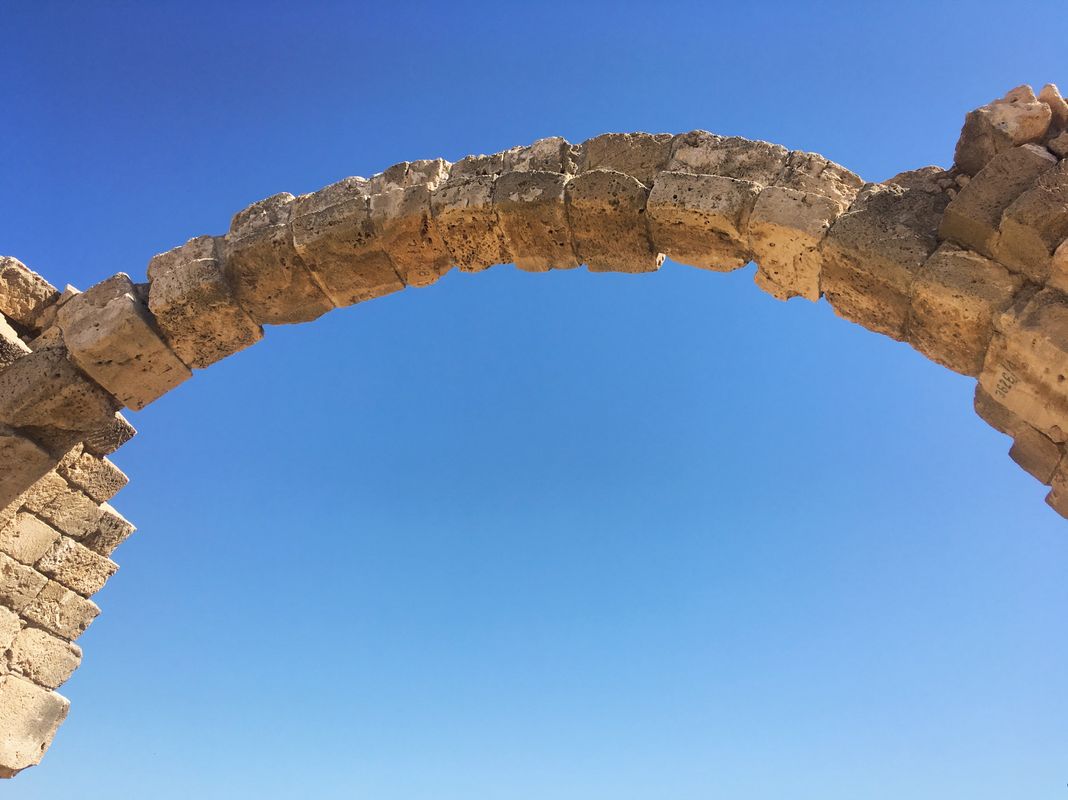
The Bible speaks of stones: cornerstones, keystones, capstones. Most of us have probably never seen a real capstone, though we have seen them on television. It is the stone at the very top of a stone arch. You have a bridge, or the mouth of a tunnel, and the stones are set in a curve and tapered just enough that they will not fall through. And the last one at the top, the one that locks everything in place — that is the capstone.
Charity is the capstone. It is what holds all the lower steps together.
Take a stone out two or three feet up from the bottom and the arch will shift. It will not come all the way down, but it will go crooked. It will not be what it was intended to be. It will be weakened. But take out the capstone at the very top, and what happens? The whole thing falls. It will not stand without the capstone.
So if we take agape out of the staircase — out of our lives — look at what happens to every step underneath it.
Faith without agape turns into religious performance. Virtue without agape becomes pride — look at me, look what I have done, look how virtuous I am. Knowledge without agape becomes arrogance — look how educated I am. Temperance without agape becomes legalism — no, you have to do it this way. Patience without agape becomes stubbornness — I am not changing, because I think I am right. Godliness without agape turns into a set of rules. And brotherly kindness without agape becomes a social club — the big feel-good churches, where everybody is made to feel good.
But set agape in its proper place, and every stone in the arch finds the purpose God cut that stone for.
Once again — and count this one — charity is the love that keeps climbing when nothing comes back.
What the Top Step Adds
I want to be clear about what this step adds to last Sunday night’s step, because it is important not to confuse them.
Philadelphia loves a brother. Agape loves an enemy. Philadelphia is warm to the familiar; agape reaches out for the stranger. Philadelphia is the love inside these walls; agape is the love that goes over the walls.
Now, I want to point out something. When God commands us to love one another, and when He says love your enemies, He is not telling this preacher, you have to have a warm fuzzy feeling and genuine affection for the people who are mean to you. What He is telling us is: behave in the best interest of those who are being mean to you. You do not have to like them. You do not have to feel warm toward them. But act in their best interest. That is what the commandment means.
Besides — can you command somebody how to feel? Do you suppose God could command us to like blue more than green? No. But He can command us to act in the best interest of our enemies. And that is the idea.
“But I say unto you, Love your enemies, bless them that curse you, do good to them that hate you, and pray for them which despitefully use you, and persecute you; That ye may be the children of your Father which is in heaven: for he maketh his sun to rise on the evil and on the good, and sendeth rain on the just and on the unjust” (Matthew 5:44–45).
To me that is the most difficult passage in the whole Bible to actually put into practice.
And there is our sun again. God’s sun rising on the evil and on the good. Agape blesses the very people who curse God’s love. The same sun that grows their food is the same sun that grows ours.
And notice the reason the Lord gives: that ye may be the children of your Father which is in heaven. He is not saying we do this in order to earn salvation. He is saying we do it because that is what our Father does — and if we are His children, we carry His nature.
Agape is not just a commandment. Agape is evidence of who our Father is.
The Inheritance
When a child inherits his father’s eyes — and we Trustys all have what look like clothespins hanging on the top of our eyes — the child did not choose those eyes. He did not earn them. He never went out and practised having a particular kind of eyes. They came with the birth, because the father’s nature went into the child.
When we are born of God, the Father’s nature goes into us. And agape is part of that nature. It does not come naturally to the flesh; it comes supernaturally to the new creation. When we are born from above, we are made a new creature.
So every time we love somebody who has not earned it — the difficult person, the hostile neighbour who is noisy at six in the morning or at midnight, whichever is least convenient, the church member who hurt us and most probably hurt us by accident, the fellow at work who gives us fits — every time, we are showing the family resemblance. We look like our heavenly Father.
Now somebody says, “Preacher, the resemblance is starting to fade in my life.” If the resemblance looks faint this evening, that is not proof that we are not saved.
A child grows into his father’s likeness, and so do we. I am about six foot five. My dad, I believe, was six foot three. When I was born, how many years did it take me to reach six foot and resemble my father in height? A long time. So do not get down in the dumps because you have been saved twenty or thirty years and still feel you fail to resemble God in loving those who do not love you back. I did not reach six foot overnight. You are not going to reach charity overnight. Growth is slow on purpose.
The Promise at the Top
“For if these things be in you, and abound, they make you that ye shall neither be barren nor unfruitful in the knowledge of our Lord Jesus Christ” (2 Peter 1:8).
This is the promise that has been waiting for us at the top of the staircase. Two words — barren and unfruitful. Not one. Both.
Barren means nothing is growing at all. If we do not climb the staircase, nothing is growing — not love, nothing. Not lost, understand. Just nothing growing.
Unfruitful refers to motion without production. Going through the motions, busy, busy, busy, and bearing nothing, with nothing spiritual to show for it.
Peter says the full staircase prevents both.
And the fruit he is describing is not a feeling. It is not a warm fuzzy. The fruit is what our life produces in the people around us.
Have you ever had a neighbour, a friend, an acquaintance who turned his life over to Jesus because of something he saw in you? Have you known a family restored because of how love was expressed in that family, through and in spite of the hurt? A church member who stayed in the faith because somebody loved him with agape right when he was hardest to love?
A life that cannot be empty is a life that has climbed the staircase. A bucket that has been dipped into a well with water in it will not stay empty.
Four Honest Questions
Is there one name — inside or outside this church — that our love has quit climbing toward?
First. Does our love depend on whether someone deserves it? If it does, that is not agape. That is a middle step. And there is no shame in being on a middle step. I finally grew to six foot five; I had no reason to be ashamed when I was five foot three. I am still growing. I stayed on the middle step most of my life and I still struggle with the charity of it. Every one of us started lower. But do not mistake a middle step for the final one.
Second. That name we just thought of — what would agape do for that person this week? Not warm feelings. We may never feel that. A choice. A decision to act for their benefit, expecting nothing in return.
Third. Are the steps under us solid, or are they wobbly? Faith, virtue, knowledge, temperance, patience, godliness, brotherly kindness. A capstone has to have an arch underneath it, or there is no place to put it.
Fourth. Have we ever asked the Holy Spirit to shed the love of God abroad in our hearts? Not as a doctrine, not help me learn a teaching — as a daily reality. Lord, let that love flow through me today. God is not withholding it. He is waiting to be asked.
What Agape Looks Like
Go back a little. Everybody knows the bad things King David did. Suppose you were the child, the son or the daughter of Uriah, the man he had killed. That was pretty bad.
Agape says: King David, I forgive you. I am never going to have a warm feeling in my heart when I see you. But I am going to act in your best interest, and I am not going to hold it against you.
And agape is God looking down at this preacher with the hammer still in his hand, after driving the nails into the hands and feet of Jesus — which is exactly what I would have been doing if I had been there. Agape says, Preacher, I forgive you. And if I had it to do over, I would sacrifice myself again for you, knowing just how guilty you are.
Supernatural love. Of course it is supernatural.
The Close
For the third and final time: charity is the love that keeps climbing when nothing comes back.
The eighth step is not the destination, and this is where so many Christians fail. The top step is the starting point. We did not climb that staircase to sit at the top and admire the view and say, well, I finally got there. We climbed so that we could see further. So that we could go further. So that we could bring more people up with us than we could ever manage to push up from the bottom.
Charity is not a trophy. Charity is a tool — the most powerful tool God ever put in a believer’s hands.
So if we are saved, that is wonderful. But salvation is not the end. It is the beginning. And if we treat the beginning as the end — on your mark, get set, go, the gun goes off, and we stand there on the track handing out high fives — we have not run the race. And nobody gets a prize who does not run the race.
Wednesday we open 1 Corinthians 13 and see what agape actually looks like in the daily situations of a real life. It is one thing to understand what the capstone is. It is another thing to know how to set it.
Scripture Used
2 Peter 1:5–7 · 2 Peter 1:8 · Romans 5:5 · 1 John 4:8 · Colossians 3:14 · Matthew 5:44–45 (all KJV)
Every lesson is kept on the Lessons page.

No comments:
Post a Comment