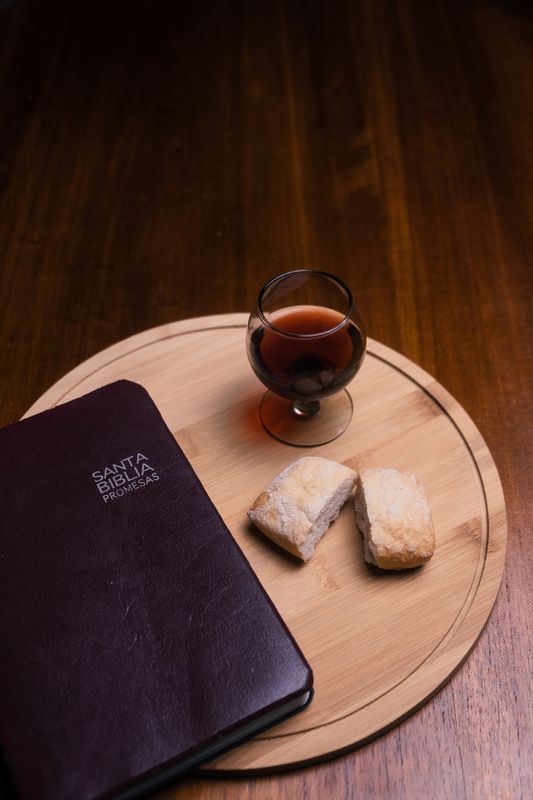
📖 The TWO Church Ordinances
Baptism, a Pictorial Ordinance · The Lord’s Supper, a Memorial Ordinance
Chuck Trusty · Pastor, Dardanelle Missionary Baptist Church · Dardanelle, Arkansas
All Scripture quotations are from the King James Version.
📖 Introduction: Two Ordinances, One Jurisdiction
God placed two ordinances — two, and no more — inside His New Testament church. Baptism is a pictorial ordinance. The Lord’s Supper is a memorial ordinance . . . ONE paints a picture . . . the other keeps a memory. Everything else in this little book hangs on those two sentences, so it is worth slowing down long enough to be sure of the words themselves.
An ordinance is a decree — a rule, a regulation, an order . . . the word is not mysterious. Towns have ordinances. Dardanelle has an ordinance that residents CANNOT let their grass grow past a certain height . . . it is a real rule with real force, and every resident of Dardanelle lives under it.
But notice something about that grass ordinance. A man who lives outside the city limits is not under it. His grass can grow to his knees and the city of Dardanelle has NOTHING to say about it. And that is not because the man is a bad man . . . it is because the man is under a different jurisdiction . . . the rule is a good rule – it simply was not addressed to him.
That one word — jurisdiction — will save us a world of confusion before this book is over . . . BOTH of the Lord’s ordinances were given to a particular body, the New Testament church, and both of them operate inside her walls . . . they are not rules floating loose over all of Christendom, binding on everyone everywhere and administered by no one in particular . . . they are church ordinances . . . the church received them, the church guards them, and the church observes them.
One more thing needs saying before we look at each ordinance in turn, and it may be the most important sentence in this introduction: neither ordinance saves anybody. Baptism does NOT wash away a single sin, and the Supper does not put a drop of grace into a single soul. Salvation is by grace through faith in the shed blood of Jesus Christ, and it is finished before either ordinance ever touches a person. “For by grace are ye saved through faith – and that not of yourselves: it is the gift of God: Not of works, lest any man should boast” (Ephesians 2:8–9). The ordinances come after salvation, not before it, and they point back at it, not toward it. Keep that fixed, and the two ordinances become plain. Lose it, and they become superstition.
⭐ Part One
Baptism — The Pictorial Ordinance
📖 Chapter One: The Picture
Every Fourth of July, this country stops to remember the struggle our forefathers made for freedom . . . and when the sun goes down, the fireworks go up. Now think about what those fireworks are . . . they are not the war . . . they NEVER were the war . . . not one rocket bursting over a ballfield in Arkansas ever won a single battle . . . the fireworks only picture the battles already fought — the bombs bursting in air over a battlefield long ago, the fight that bought the freedom we now enjoy.
That is baptism.
Baptism wins no battle for the soul. Baptism pictures the battle Jesus already fought — His death, His burial, and His resurrection . . . when a believer goes down into the water and comes up out of it, the church watching from the banks or the pews is being shown a picture: Christ died, Christ was buried, Christ rose again . . . and she is being shown a second picture laid on top of the FIRST: this believer died to the old life, the old man was buried, and a new creature came up to walk a new road.
Paul draws the picture in so many words. “Therefore we are buried with him by baptism into death: that like as Christ was raised up from the dead by the glory of the Father, even so we also should walk in newness of life . . . for if we have been planted together in the likeness of his death, we shall be also in the likeness of his resurrection” (Romans 6:4–5). Notice Paul’s words — buried, planted, raised. Baptism is a likeness . . . it is a picture of the thing, NOT the thing itself.
That is why we call baptism a pictorial ordinance. A picture has one job: to show truly. A picture of the courthouse that looks like the river bridge is not a poor picture – it is a false one . . . so the great question about baptism is always the same question we would ask of any picture — does it show the thing truly? Keep that question in hand . . . it will answer nearly EVERYTHING men have ever argued about baptism.
📖 Chapter Two: A Believer First
The first thing the picture demands is a believer. Baptism pictures a death, a burial, and a resurrection that have already happened — Christ’s, on the believer’s behalf, and the believer’s own death to sin (not death to the practice — but death to its power to control against his will) through faith in Him. You cannot honestly bury a man who has not died . . . put a living man in the ground and you have not conducted a funeral – you have committed a crime . . . just so, to baptize a person who has NEVER been saved is to paint a picture of something that never took place.
The pattern in Scripture is fixed and NEVER once reversed: first faith, then water . . . when the Ethiopian eunuch heard Jesus preached and saw water by the roadside, he asked, “See, here is water – what doth hinder me to be baptized?” And Philip’s answer set the door of the baptistery exactly where it belongs: “If thou believest with all thine heart, thou mayest . . . and he answered and said, I believe that Jesus Christ is the Son of God” (Acts 8:36–37). Belief first. Water second. At Pentecost the order is the same: “Then they that gladly received his word were baptized” (Acts 2:41). They received the word gladly — that is, they were saved — and then they were baptized into a church that was not born on Pentecost, but which GREW larger on Pentecost, having been born during the earthly ministry of Jesus.
This is why we do not baptize infants, and it is worth being tender and clear about the reason . . . it is not that we think little of babies – the Lord took them up in His arms and blessed them . . . it is that a baby CANNOT yet believe, and baptism is a testimony that belief has happened. A testimony given before the fact is not a testimony at all.
And this is also why baptism cannot save . . . some point to Peter’s words — “the like figure whereunto even baptism doth also now save us” — and stop reading a breath too soon. Peter finishes the sentence himself: “not the putting away of the filth of the flesh, but the answer of a good conscience toward God, by the resurrection of Jesus Christ” (1 Peter 3:21). Peter says plainly that baptism is a figure — a picture — and that the saving power is the resurrection of Jesus Christ, not the water . . . the water NEVER touches the soul . . . it only tells, in a language every eye can read, what the blood has already done.
📖 Chapter Three: Much Water
The second thing the picture demands is a burial . . . and a burial requires going under.
The Bible word translated baptize means to immerse — to dip, to plunge, to put under . . . and EVERYTHING Scripture shows us about the practice agrees with the word. “And John also was baptizing in Aenon near to Salim, because there was much water there” (John 3:23). A man does not need much water to sprinkle a few drops on a head – he needs much water to bury a body . . . when the Lord Himself was baptized, “Jesus, when he was baptized, went up straightway out of the water” (Matthew 3:16) — He had been down in it. When Philip baptized the eunuch, “they went down both into the water” (Acts 8:38), and came up out of it.
Now hold up the picture again and ask our one question: does it show truly? Baptism pictures a death, a burial, and a resurrection. Immersion shows ALL three — down into the water as into a grave, under the water as in the tomb, up out of the water as Christ came out on the third morning. Sprinkling shows none of them . . . this is not a quarrel over quantity, as if God were counting gallons . . . it is a matter of the picture. Change the mode and you have not adjusted the ordinance – you have erased the painting and hung a different one in its frame . . . we are “buried with him by baptism” (Romans 6:4). No burial, no picture. No picture, no baptism.
📖 Chapter Four: By Whose Authority
The third thing the picture demands is a hand authorized to hold the brush.
Baptism did not begin with men, and men were never left free to administer it however they pleased. “There was a man sent from God, whose name was John” (John 1:6) — the first administrator of baptism came with credentials from heaven. And when the risen Lord gave the ordinance its standing orders, He gave them to His church: “Go ye therefore, and teach all nations, baptizing them in the name of the Father, and of the Son, and of the Holy Ghost: Teaching them to observe all things whatsoever I have commanded you: and, lo, I am with you alway, even unto the end of the world” (Matthew 28:19–20). That commission was not handed to mankind at large. It was handed to the church He had gathered and taught — with a promise to be with her to the end of the world, which tells us He expected her to be here that long, still teaching, still baptizing.
So baptism is a church ordinance, exactly as the Supper is. Here is our grass ordinance again: a rule means little without a jurisdiction to keep it. If baptism belonged to everybody, it would be defined by nobody, and any man with a bucket could make the picture say anything he pleased — and looking around today, that is very nearly what has happened. God lodged the ordinance in His church so the picture would be guarded: a saved subject, a true mode, a right meaning, under the watch and authority of a New Testament church.
Put the three demands of the picture together and baptism becomes simple. A believer — because the picture testifies of a salvation already received. Immersion — because the picture shows a burial and a resurrection. Church authority — because the Lord left His picture in the keeping of His church. Baptism saves no one and was never meant to. It is the fireworks, not the war. But when it is done as the Lord gave it, there is not a sermon in the world that preaches the death, burial, and resurrection of Jesus Christ more plainly to the human eye.
⭐ Part Two
The Lord’s Supper — The Memorial Ordinance
📖 Chapter Five: A Memorial
Come back to the Fourth of July one more time, because that one day shows us BOTH ordinances at once.
We keep the Fourth every year to remind us of the struggle our forefathers made for freedom . . . the purpose of the celebration is so we will not forget . . . the fireworks are the picture — we have already said that is baptism . . . but the day itself, kept over and over, year after year, is a memorial . . . NOBODY keeps the Fourth to win independence. Independence has already been won . . . we keep the day so a free people will not forget what their freedom cost.
That is the Lord’s Supper.
The Supper adds NOTHING to salvation, just as the Fourth of July adds nothing to 1776. The Supper is kept so a redeemed church will not forget what her redemption cost . . . on the night He was betrayed, the Lord took bread and the cup and said, “this do in remembrance of me” (1 Corinthians 11:24–25). And Paul tells the church what her observance amounts to: “For as often as ye eat this bread, and drink this cup, ye do shew the Lord’s death till he come” (1 Corinthians 11:26). Every time a church eats this bread and drinks this cup, that church preaches the Lord’s death without a word being said.
Notice, too, the difference in frequency, because it follows from the difference in kind. Baptism is once — a picture of what saved us, made after we are saved, NEVER repeated, because Christ died once and we died to the eternal effects of sin once. The Supper is “as often as ye eat” — with no set time given, because a memory needs refreshing again and again. A picture is painted once and hangs. A memorial is kept and kept and kept.
And notice one thing more, the thing this little book most wants remembered. Paul writes, “Husbands, love your wives, even as Christ also loved the church, and gave himself for it” (Ephesians 5:25). Christ loved the church and gave Himself for it. Not ONLY what Jesus did for each one of us singly — specifically, what Jesus gave for the church. The Supper is not a private devotion that happens to be held in a crowd . . . it is the bride at the table, remembering the price her Bridegroom paid for her.
It is TRUE that Jesus died for us as individuals to pay the price for our salvation — but that is not the context of this particular discussion . . . all the saved do not define the New Testament church – rather, the saved who choose to be obedient to proper baptism are qualified to be part of the church — for which the death of Jesus also provided the strength and power to preserve her till the end of the age.
Say it plainly, because EVERYTHING else in Part Two rests on it: the Lord’s Supper is not the individual remembering — it is the church remembering what Jesus gave for her.
📖 Chapter Six: Whose Table
If the Supper is the church remembering, then the question of who sits at the table has already been answered before it is asked . . . but it deserves its OWN chapter, because no part of this subject is more misunderstood, and no misunderstanding causes more hurt feelings than this one — usually because jurisdiction gets mistaken for judgment.
Go back to Dardanelle’s grass ordinance . . . the rule binds residents of Dardanelle. A man who lives in Russellville is not under it — not because he is a bad man, but because he is under a different jurisdiction . . . now suppose the city tried to enforce Dardanelle’s ordinance on that Russellville man just because he lives in Arkansas. Everyone would see the confusion at once: the rule is real, but it was NEVER addressed to him.
The Lord’s Supper is a church ordinance. The Supper is not a rule that applies to everyone who is saved, everywhere, all at once. The Supper applies to the members of the church where the Supper is being observed. Paul wrote his instructions about the table “unto the church of God which is at Corinth” (1 Corinthians 1:2) — to a particular body in a particular place, about a table set inside her own fellowship . . . the discipline that guards the table (we will come to it in the next chapter) is discipline a church can only exercise over her own members. A church CANNOT examine, restore, or put away people who do not belong to her. Her table runs exactly as far as her jurisdiction runs, and no farther . . . to consider otherwise would introduce a doctrine of salvation that is not eternal but could be lost — which is found nowhere in the Scriptures . . . if we fail to “rightly divide” the Word, the error which results can be far-reaching.
So when a church observes the Supper with her own membership, she is saying NOTHING — nothing — about the salvation, the sincerity, or the worth of any visitor in the building. A saved man visiting from another church is not being called an outsider to Christ – he is simply outside this jurisdiction, as a Russellville man is outside Dardanelle’s. The table is not a scale that weighs souls . . . it is a family memorial, kept by the family that is keeping it, and the guest who understands that has not been slighted any more than a Dardanelle man is slighted by not being fined under Russellville’s ordinances.
📖 Chapter Seven: Unworthily — The Word the Church Must Get Right
Now we come to the word that has kept more of God’s people away from the table than any other word in the Bible, and it will turn out that the word NEVER meant what they feared it meant.
“Wherefore whosoever shall eat this bread, and drink this cup of the Lord, unworthily, shall be guilty of the body and blood of the Lord” (1 Corinthians 11:27).
Unworthily . . . how many believers have sat in a pew and let the plate pass because that word thundered at them — you are not worthy? But look at the word Paul actually wrote. His word is anaxiōs — say “an ax,” then “EE,” then “oce,” rhyming with dose — and it is an adverb. An adverb is a HOW word . . . it does not describe the person at the table . . . it describes the manner of the eating. Paul did not write “whosoever unworthy shall eat” – he wrote “whosoever shall eat... unworthily.” The word describes the eating, NEVER the eater.
And hear this well: not one of us at any table is worthy — that is the whole reason there is a table . . . if worthiness of person were the ticket, every seat in every church house would sit empty until the Lord comes . . . the blood of Jesus is what makes us worthy to sit there . . . so the question is NEVER “are we worthy people.” The question is: does the manner of our observance honor what this table remembers?
Now notice who Paul is talking to, because this is the second key that unlocks the chapter. Every “ye” in 1 Corinthians 11 is plural — more than one. Paul is NOT writing to a man. Paul is writing to a church, assembled in the city of Corinth . . . and that church had come to the table divided — split into factions, some members feasting drunk while other members went hungry . . . that church ate unworthily — as a church . . . the unworthy manner Paul actually names is not a trembling believer’s private sense of failure . . . it is a congregation handling holy things carelessly.
A church eats the Supper unworthily when the church is irreverent . . . when unscriptural things are allowed to be taught or practiced among her . . . when open misbehavior in the membership goes unchallenged — and this is why church discipline should NEVER be ignored, for discipline is not cruelty – discipline is how a church keeps her table honest . . . when a church lives like the world Monday through Saturday and dresses up like a church on Sunday, that church is being irreverent toward God and toward the Lord’s Supper, whatever her manners look like at the observance itself.
Briefly, let me describe what the error of the Corinth church — observing the Supper in an unworthy manner — would look like in one of our churches today . . . suppose it was fellowship Sunday, and we had ALL the food to satisfy our appetite on one table: the meat loaf, the beans, the potatoes, and the peach cobbler . . . on the adjacent table there were two items — a plate containing unleavened bread, and a tray holding the little cups of grape juice . . . to observe the Supper unworthily would mean that while I was filling a plate with meat loaf to satisfy my appetite, I would quickly step over and take a bit of bread and drink a cup of juice — saying a quick prayer of thanks to God — so I could hurriedly get to my meat loaf and peach cobbler and begin visiting, so I could hear the latest gossip . . . that is not exactly what the church at Corinth did, but it is a fairly accurate description . . . that is what it means for a church to partake of the Supper in an unworthy manner. Now, a church may not actually set the meat loaf next to the Lord’s Supper — but what about setting our appetite to please the world next to our appetite to please God? If our appetite to please men is large while our appetite to please God is small, can you see that we are piling the meat loaf on our plate — and barely noticing the unleavened bread and the grape juice?
Paul had already told this SAME church what such guarding looks like: “But now I have written unto you not to keep company, if any man that is called a brother be a fornicator, or covetous, or an idolater, or a railer, or a drunkard, or an extortioner – with such an one no not to eat” (1 Corinthians 5:11). And again: “But them that are without God judgeth. Therefore put away from among yourselves that wicked person” (1 Corinthians 5:13). Open, unrepented sin is the church’s business — intended to be settled before the table is set, not ignored at the table.
Not that any member is expected to live perfectly. No member ever has . . . but every member is expected to live inside the boundaries of God’s Word, and inside the boundaries of love . . . the church CANNOT be taken out of the world — but something is wrong when the church lives no differently from the world around her.
📖 Chapter Eight: Examine — and Eat
If chapter seven took a burden off the believer’s shoulders, this chapter tells him what to do instead — and the instruction ends somewhere many people have NEVER noticed.
“But let a man examine himself, and so let him eat of that bread, and drink of that cup” (1 Corinthians 11:28).
There is the examination — yes . . . EVERY heart is to take its inventory . . . but watch where the sentence ends: “and so let him eat.” The examination is not a doorway out of the Supper . . . the examination is the doorway into the Supper. Paul does not say, examine yourself, and if you find sin, stay away. He says, examine — and so eat . . . we take inventory of the heart . . . we confess what we find there . . . we repent . . . and then — forgiven — we eat. The Supper is not a table for perfect people. The Supper is a table for a repenting church, full of repenting people.
Paul goes on: “For he that eateth and drinketh unworthily, eateth and drinketh damnation to himself, not discerning the Lord’s body” (1 Corinthians 11:29). To discern is to set apart — to treat as different . . . if the Supper becomes just another thing the church does — no reverence, no feeling for what Jesus actually suffered — then we eat judgment and not remembrance . . . the bread must NEVER become ordinary bread in our hands — like the meat loaf or the peach cobbler.
And the Lord does not treat carelessness at His table as a small thing. “For this cause many are weak and sickly among you, and many sleep” (1 Corinthians 11:30). That is chastisement — directed toward a church that eats carelessly — which means a church can be a church that God puts on the sick bed . . . but mercy stands one verse away: “For if we would judge ourselves, we should not be judged” (1 Corinthians 11:31). To judge ourselves is to volunteer — to separate ourselves from what displeases God before God has to do the separating for us. That is the WHOLE rhythm of the table: examine, confess, repent, eat, remember.
On the night the Supper was given, “as they were eating, Jesus took bread, and blessed it, and brake it, and gave it to the disciples, and said, Take, eat – this is my body . . . and he took the cup, and gave thanks, and gave it to them, saying, Drink ye all of it – For this is my blood of the new testament, which is shed for many for the remission of sins” (Matthew 26:26–28). Then He looked past the cross to the far side of it: “I will not drink henceforth of this fruit of the vine, until that day when I drink it new with you in my Father’s kingdom” (Matthew 26:29). The Supper looks back to the cross and forward to the kingdom at the SAME time — “ye do shew the Lord’s death till he come.” One day the memorial will give way to the Marriage Supper, and the remembering will be done face to face. “And when they had sung an hymn, they went out into the mount of Olives” (Matthew 26:30).
📖 Conclusion: The One Point
Two ordinances — two, and no more — and one Lord who gave them BOTH to His church.
Baptism is the picture: painted once, after salvation, showing in water what the blood already did — a death, a burial, and a resurrection. The Supper is the memorial: kept as often as the church gathers to keep it, so that the bride will NEVER forget the price her Bridegroom paid . . . neither one saves . . . both preach . . . and both belong to the jurisdiction of the New Testament church, which received them from the Lord’s own hands and is charged to keep them true till He comes.
If this little book leaves one sentence with you, let it be the one that stands at the center of it, the point worth saying until it CANNOT be forgotten:
📖 Hear It Preached
This little book grew out of a sermon preached at Dardanelle Missionary Baptist Church . . . you can watch that sermon here:
This study was preached at the table on Wednesday evening, August 12, 2026. That lesson is posted as Examine, and So Eat — on what the word unworthily actually describes.
Dardanelle Missionary Baptist Church — Dardanelle, Arkansas

No comments:
Post a Comment