This is Chapter 3 of a free seven-chapter booklet, What Does the Bible Say? — A Simple Foundation for New Believers. You can start at Chapter 1 or see all seven chapters on The Basics page.
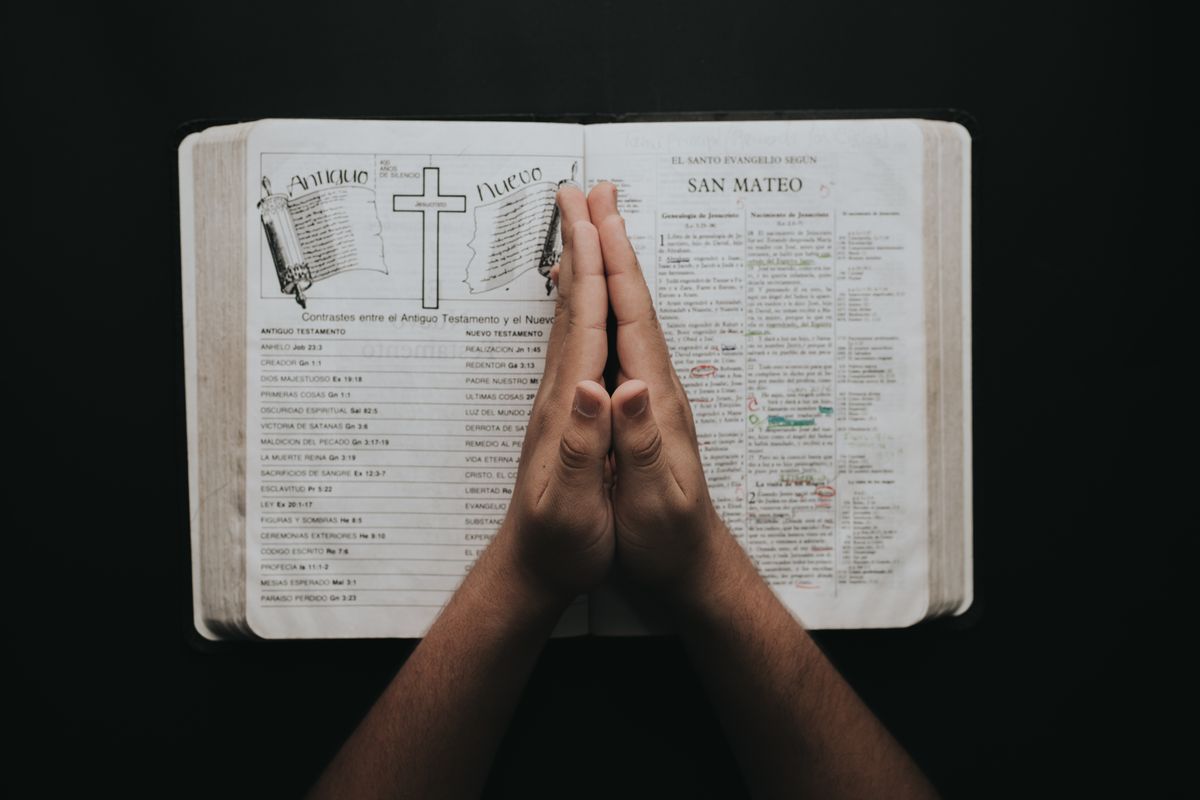
📘 CHAPTER THREE — What Does the Bible Say About Prayer?
Learning to talk with your Father
⭐ Introduction
Chapter Two settled the biggest question there is — you are saved, and you are safe in two hands that will not let go. Now here comes a question that will fill up the REST OF YOUR LIFE . . . how do you talk to the God who saved you?
Every new believer wonders about it, even the ones who are afraid to say it out loud. Do I have to use special words . . . do I have to sound like the preacher . . . what about it when my mind wanders off, or when I fall asleep before I ever get finished? And notice we are not asking what a ritual says about it, and we are not asking about something we saw somebody do on television — we are asking the very same thing we asked about salvation: what does the Bible say?
And the Bible’s answer is a good deal simpler, and a good deal kinder, than most of us would expect.
I. Prayer Is Simply Talking to God
Prayer is not a performance, and it is not a magic spell where the right words open the door and the wrong words leave it shut . . . prayer is a child talking to his Father . . . listen to how the Lord Jesus taught us to start out:
“After this manner therefore pray ye: Our Father which art in heaven, Hallowed be thy name.” — Matthew 6:9
Before we ask for one single thing, Jesus hands us the first two words — OUR FATHER. And remember what Chapter Two said . . . the minute we were saved we became God’s CHILDREN. So when we pray we are not some stranger out knocking at a rich man’s gate and hoping he answers — we are a child walking into his own Father’s house. That ONE truth changes about everything there is to change about how praying feels.
And a child does not make an appointment to go talk to his daddy . . . he does not rehearse a speech and he does not reach around for fancy words — he just climbs up and starts talking. God is NOT sitting up there grading our grammar:
“But when ye pray, use not vain repetitions (saying the same thing over and over without meaning it), as the heathen do: for they think that they shall be heard for their much speaking. Be not ye therefore like unto them: for your Father knoweth what things ye have need of, before ye ask him.” — Matthew 6:7–8
Read that last line again slow . . . our Father ALREADY KNOWS what we need before we ever open our mouth . . . so praying is not us bringing God news that He has not heard yet. It is a child telling his Father what is on his heart — because that is what children do, and because the Father loves to hear it.
Who do we pray to? New believers ask that one plainly, so let us let the Bible answer it plainly. We pray to the Father — “Our Father which art in heaven” — and we come in the name of Jesus, because He is the One who opened the door:
“…Verily, verily, I say unto you, Whatsoever ye shall ask the Father in my name, he will give it you.” — John 16:23
To the Father, in the name of the Son — and that is the pattern all the way through the Book. We do not need any middle-man down here on this earth . . . and we do not pray to anybody else. The way is open and it has our Savior’s name over the door.
Simple truth: Prayer is a child talking to his Father — not a speech delivered to a stranger.
II. Prayer Is Learned — Even His Own Men Had to Ask
If praying feels awkward to us at first, then let us take heart, because we are in good company. Grown men who walked with Jesus every day of the week, who watched Him pray of a morning and again at night, came to Him with a request:
“And it came to pass, that, as he was praying in a certain place, when he ceased, one of his disciples said unto him, Lord, teach us to pray, as John also taught his disciples.” — Luke 11:1
Now notice they did not say teach us to preach . . . and they did not say teach us to do miracles. They said TEACH US TO PRAY. And these men were not beginners at religion — and still they had to be taught. So if we feel like a beginner at it, we are standing in the exact spot where the very first disciples stood . . . praying is a learned thing, and the Lord Himself is PATIENT with learners.
And look at what He handed them when they asked. Not a feeling — and not “just let it flow” — He gave them a pattern to walk through:
“After this manner therefore pray ye: Our Father which art in heaven, Hallowed be thy name. Thy kingdom come. Thy will be done in earth, as it is in heaven. Give us this day our daily bread. And forgive us our debts, as we forgive our debtors. And lead us not into temptation, but deliver us from evil: For thine is the kingdom, and the power, and the glory, for ever. Amen.” — Matthew 6:9–13
Now mark this carefully, because it is EASY to get wrong. Jesus said “after this manner” — and that means pray along these lines, and it does not mean recite these exact words and nothing else . . . because remember He had just finished warning us about vain repetitions. The model prayer was never meant to be a paragraph said by memory without thinking about it — it is an outline to walk down, a set of doors to open, one at a time.
His name honored . . . then His kingdom and His will put first . . . then our daily needs . . . then forgiveness, asked for and given out . . . then help against temptation. So when our mind goes blank we are never stuck, because we have got doors to walk through and the Lord Himself drew us the map.
Illustration — The Trellis. A tomato vine left to itself will sprawl out in the dirt and the fruit will rot on the ground. Now give that same vine a trellis — a few plain stakes and some string — and it climbs, and it bears, and a man can find the fruit when he goes looking for it. That vine is not one bit less alive for having something to climb on . . . it is more fruitful . . . and the model prayer is a trellis for a wandering mind. It does NOT make our praying stiff — it gives it something to climb.
A Word Worth Knowing — “Watch and Pray.” On His last night the Lord told His men to “watch and pray” (Matthew 26:41). In the original language both of those words carry the sense of KEEP ON — keep watching, keep praying. He was not telling them to say one prayer and then be done with it . . . He was describing a life kept turned toward God, the way a sunflower holds its face to the sun all day long. And that is how the Bible can turn around and say “Pray without ceasing” (1 Thessalonians 5:17) — which does not mean never stop talking. It means never TURN AWAY.
Simple truth: NOBODY is born knowing how to pray — and the Lord who taught His first men to pray is teaching us now.
III. Does God Really Hear Me?
Here is the fear that hides down underneath a new believer’s prayers . . . maybe the ceiling is as high as it goes . . . maybe there is NOBODY listening. And the Bible speaks straight at that fear, because God hears His children and He says so plainly:
“Evening, and morning, and at noon, will I pray, and cry aloud: and he shall hear my voice.” — Psalm 55:17
“For the eyes of the Lord are over the righteous, and his ears are open unto their prayers…” — 1 Peter 3:12
His ears are OPEN to His own . . . not cracked open on our good days and shut on our bad ones — but open.
Now somebody is going to honestly ask it: then what about the times my prayers feel like they hit the ceiling and bounce back down? And the Bible is honest about that too, because it names ONE thing that will cloud up the line:
“If I regard iniquity in my heart, the Lord will not hear me.” — Psalm 66:18
Read it slow, because it is gentler than it sounds the first time through. It does not say “if I ever sin” . . . it says if I REGARD iniquity — if I cherish it, hold on to it, hide it down in my heart and refuse to turn it loose. That is not God turning His back on a stumbling child . . . that is the very thing Chapter Two taught us about being His child and having fellowship with Him: sin in a believer’s life clouds up the closeness, and it NEVER touches whether we are His. Our Father is STILL our Father. And there is a one-verse remedy for it, and it is ALWAYS standing open:
“If we confess our sins, he is faithful and just to forgive us our sins, and to cleanse us from all unrighteousness.” — 1 John 1:9
We never have to clean ourselves up before we come . . . we just come HONEST. Tell Him what He already knows, and the closeness is put back that VERY MINUTE.
A Word Worth Knowing — “The Working Prayer.” James makes a promise here that ought to put some steel in a new believer’s spine:
“…The effectual fervent prayer of a righteous man availeth much.” — James 5:16
“Effectual fervent” is two English words carrying one word out of the original — and our own word energy is hiding inside of it. It means THE WORKING PRAYER . . . prayer with its sleeves rolled up, prayer that is ACTUALLY DOING SOMETHING, instead of words left idling with the engine off.
And “a righteous man” — now do not read right on past that and think to yourself, well, that leaves me out. Because the righteous man here is simply a SAVED man. Chapter Two settled that one: his righteousness is a gift put to his account, and it is not something he earned. This promise was never written for the spiritual giants . . . it was written for US.
Illustration — The Clean Pipe. Water runs through a pipe not because the pipe is strong but because the pipe is open. Let rust and gunk fill that pipe up and the water will only trickle out the end of it. The power was NEVER in the pipe at all — it was in the water, and in the pressure behind the water. And confession is what keeps our pipe clean and open . . . so that all the strength of God can run right through the prayer of a weak man. The might is NOT in us . . . it is in the One who is receiving the prayer.
Simple truth: God’s ear is open to His children — and honest confession is what keeps the line CLEAR.
IV. When the Answer Comes
Jesus told a whole parable for one reason, and Luke wrote the reason down for us — so that we would keep on praying and not give up:
“And he spake a parable unto them to this end, that men ought always to pray, and not to faint (not to give up and quit).” — Luke 18:1
To “faint” is to QUIT . . . to let the arms drop down. And sometimes we quit because the answer has not come yet and we go on and decide that God must not be listening — but a delay is NOT a DENIAL. The Bible teaches us to KEEP ON coming, like a child who is not one bit afraid to ask his father twice.
Now here is the part a new believer needs to get settled early on: God answers every prayer His children pray — He just does not always answer YES. And no good father does. Even the apostle Paul asked three times for one thing, and God’s answer to him was no:
“For this thing I besought the Lord thrice, that it might depart from me. And he said unto me, My grace is sufficient for thee: for my strength is made perfect in weakness…” — 2 Corinthians 12:8–9
Paul begged for that thorn to be taken away . . . and God said no — and then God turned around and told him why: something better than relief was coming, and it was only going to come through the very weakness Paul wanted gone. That “no” was not God ignoring Paul . . . that was God loving Paul too much to hand him the smaller thing he was asking for.
Illustration — Three Answers, One Good Father. Any parent in here knows there are three honest answers to a child’s request — yes . . . not yet . . . and no, because I love you. The child who reaches up for the carving knife on the counter is not being rejected when his mother tells him no — he is being PROTECTED. And some of the kindest things our Father ever does for us, He does by telling us no about the very thing we were DEAD SURE we needed. We will understand it later on . . . for right now we trust the One who is doing the answering.
⭐ Let the Bible Explain the Bible — “Ask Anything?”
New believers will trip over a verse like “ask, and ye shall receive” (John 16:24) and take it to mean that God is some kind of vending machine — put in the prayer and out drops the thing. So let us let Scripture explain Scripture, because the same Bible says two things that stand guard over that promise. First: “ye ask, and receive not, because ye ask amiss” (James 4:3) — and that means some of what we ask for is simply the WRONG thing to be asking for. And second: “if we ask any thing according to his will, he heareth us” (1 John 5:14). So the promise is real . . . but it runs through God’s good will and not around it. That is not a loop-hole . . . that is a mercy. Would any one of us really want a God who handed us every single request, including the ones we would be weeping over a year from now? “Thy will be done” is the SAFEST prayer we will ever pray.
Simple truth: God answers every prayer His children pray — sometimes yes, sometimes not yet, and sometimes a “no” that is pure love.
V. But I Keep Falling Asleep
Maybe this is the most honest question of the whole bunch . . . what about the nights I mean to pray, and my mind wanders off somewhere, or I fall asleep before I ever finish? Well the Bible has a scene in it for exactly that — and it is one of the tenderest scenes in the whole Book.
On the night before the cross, Jesus took His three closest men out into a garden to pray and asked them to watch with Him. And He came back and found them asleep:
“And he cometh unto the disciples, and findeth them asleep, and saith unto Peter, What, could ye not watch with me one hour? Watch and pray, that ye enter not into temptation: the spirit indeed is willing, but the flesh is weak.” — Matthew 26:40–41
Now look at who it was that went to sleep . . . NOT the weak ones — His three best. And then look at what Jesus did not do . . . He did not disown them, and He did not call them lazy . . . He said the kindest thing He could have said: “the spirit indeed is willing, but the flesh is weak.” He was telling them I know your heart wanted to . . . I know your body had nothing left in it. Their spirit was eager and their flesh was worn out — and so is ours, because that very same weakness lives in EVERY LAST ONE of us.
So the Bible does not scold weak pray-ers . . . it HELPS them. Here are five plain helps, and let us hear them as permissions and not as one more burden, because every one of them comes straight out of the Book:
Pray on your feet. Isaac “went out to meditate in the field at the eventide” (Genesis 24:63). There is nothing in the Bible anywhere that requires a chair or a bowed head . . . and a body in motion does NOT doze off — so if the kneeling hour keeps putting us to sleep, then get up and walk and pray.
Pray out loud. David prayed “…and cry aloud: and he shall hear my voice” (Psalm 55:17). Silent prayer is where the mind slips off the road, and the voice is what holds it on . . . because it is HARD to fall asleep while we are talking.
Pray with a list. Paul kept names — “always in every prayer of mine for you all” (Philippians 1:4). There is NO shame at all in a written list of folks to pray for . . . a wandering mind is glad of a fence.
Pray with the Book open. When our own words run out, God’s have not. Read a psalm out loud and pray it back to Him. Psalm 1 is only six verses — read it slow, and ask God to make us like that tree planted by the rivers of water.
Give God a good hour. If the sleepy tail-end of the day keeps swallowing our prayers, then move the hour and give Him one when we are awake. The Bible commands the habit of prayer and it does not command a particular time on the clock . . . Jesus prayed before daylight (Mark 1:35) and Jesus prayed all night long (Luke 6:12) — so the hour changed and the habit NEVER did. It is the same principle as the firstfruits — “Honour the LORD… with the firstfruits” (Proverbs 3:9) — God is worth the best of our day, and not the leftover minutes when we are already half asleep.
Simple truth: The flesh is weak in all of us — and the Lord meets tired, wandering pray-ers with help instead of a scolding.
🕊️ Before You Leave This Chapter
Let me ask you something, friend — and not “do you know how to pray,” but this: have you talked to your Father today? Not a speech . . . not the right words . . . just talked to Him.
If prayer has felt like a closed door, then hear the whole chapter at one time. You are His child, so the door is OPEN . . . He already knows what you need . . . He is patient while you are learning . . . His ear is open, and confession keeps the line clear . . . He answers every single time, whether it is yes, or not yet, or a loving no. And when you are weak and sleepy and your mind wanders off, He is not disgusted with you — He understands it, and He helps.
So do not go waiting around until you can do it well . . . put this booklet down for a minute and go talk to Him — on your feet if you like, out loud if it helps. Tell Him where you are . . . that is PRAYER. You just PRAYED.
And here is the sweetest part of the whole thing — while you are still learning to pray for yourself, Somebody is already praying for you:
“…he ever liveth to make intercession for them.” — Hebrews 7:25
The Lord who once asked Peter for one hour has NEVER one time stopped giving us His. On our best day and on our sleepiest one — Jesus is praying FOR US.
⭐ Chapter Summary
- Prayer is simply a child talking to his Father — no fancy words and no performance.
- We pray to the Father, in the name of Jesus — and He already knows what we need.
- Praying is learned, and even His own men had to ask — and the model prayer is a trellis and not a chant.
- God’s ear is open to His children . . . and confession (1 John 1:9) keeps the line clear.
- God answers every prayer — yes, not yet, or a “no” that is love — always according to His good will.
- The flesh is weak in all of us — so pray on your feet, out loud, with a list, with the Book open, at your best hour.
- And all the while, Jesus Himself is praying for us.
Next — Chapter Four: What does the Bible say about worship?

No comments:
Post a Comment