This is Chapter 5 of a free seven-chapter booklet, What Does the Bible Say? — A Simple Foundation for New Believers. You can start at Chapter 1 or see all seven chapters on The Basics page.
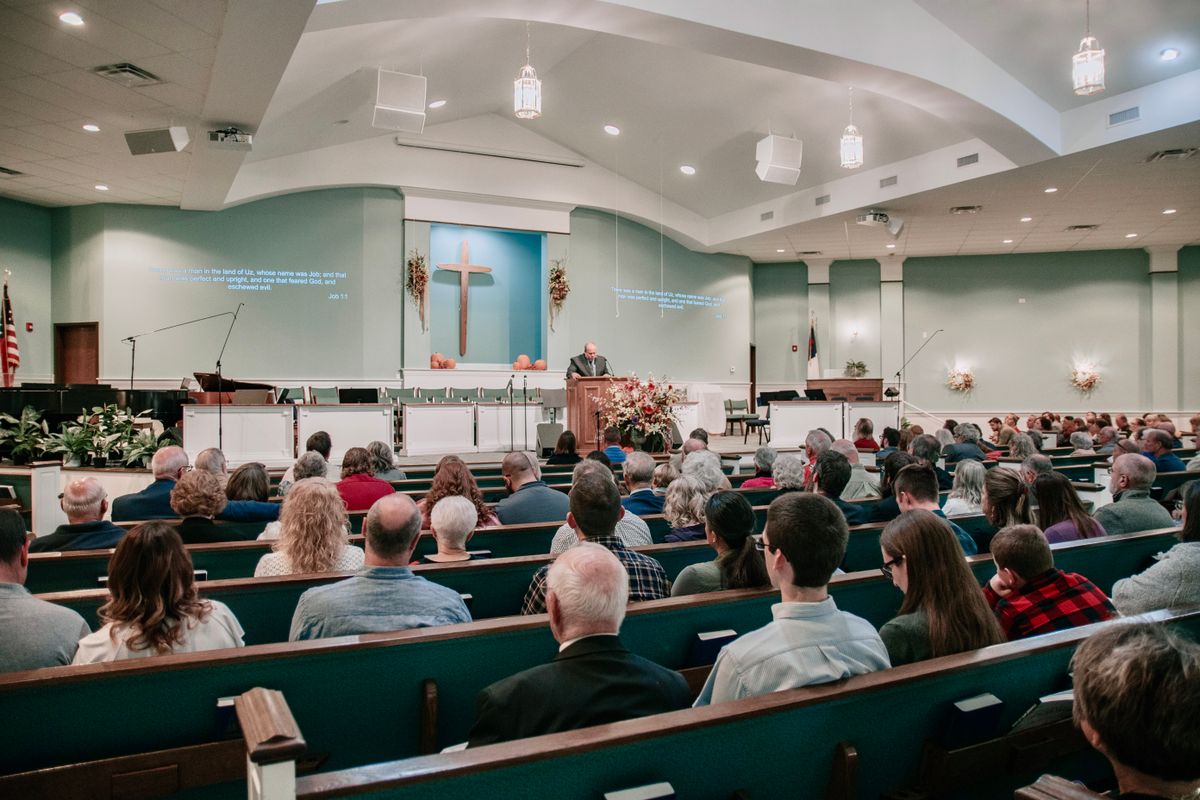
📘 CHAPTER FIVE — What Does the Bible Say About the Church?
Not a building, not a vague idea — a called-out people Jesus built to last
⭐ Introduction
Chapter Four opened up worship, and one of the FIRST things worship does is bring us together — "not forsaking the assembling of ourselves together." That raises the next honest question a new believer carries: what exactly is this thing we assemble into? What is the church?
Ask most people and they point at a building with a steeple. Ask others and they wave a hand toward the sky and say, "the church is all believers everywhere." The Bible says something plainer and better than either one. The church is a people — a called-out people — that the Lord Jesus started with His own hands, that meets in a real place, and that He promised would NEVER die . . . you were not saved to walk alone . . . you were saved to belong.
Let us ask the Book.
I. The Church Is Not a Building — It Is a People
The word the New Testament uses for "church" NEVER meant a building . . . in the language it was written in, the word is ekklesia, and it means a called-out assembly — a group of people called out and gathered together. A building has no faith. A building cannot pray, cannot be baptized, cannot love a brother or carry his burden. People do those things.
So when the Bible says "church," do NOT picture bricks. Picture people — saved people, gathered.
Illustration — The Barn and the Herd. Out on a place, NOBODY points at the barn and calls it the cattle. The barn is just where the herd comes in out of the weather. The herd is the living thing. Burn the barn to the ground and you still have your cattle — they will gather under a tree. The building where a church meets is the barn. The called-out, blood-bought people are the herd . . . do not confuse the two.
Simple truth: The church is people, NOT a place — a called-out people, saved and gathered.
II. Jesus Built It Himself — and It Will Not Die
Listen to who started the church, and when:
"And I say also unto thee, That thou art Peter, and upon this rock I will build my church; and the gates of hell shall not prevail against it." — Matthew 16:18
Notice three things sitting in that one verse. First, "I will build" — Jesus is the builder. The church is not a club men dreamed up – it is a work of Christ, and He began building it in the days of His own ministry here on earth. Second, "my church" — it belongs to Him. Third, "the gates of hell shall not prevail against it" — it will NEVER be destroyed. From the day the Lord started building it, His church has never gone out of existence, and it never will. Kingdoms have risen and fallen . . . His church is still here.
And one word about that rock, because it trips people up. When Jesus said this, He and His disciples were up at Caesarea Philippi, standing before a huge wall of stone — a great rock cliff . . . He had just asked, "whom say ye that I am?" and Peter had answered, "Thou art the Christ, the Son of the living God" (Matthew 16:16). So when the Lord says, "thou art Peter" — and the name Peter means a stone, a little stone — "and upon this rock I will build my church," He is not building His church on little Peter . . . He points past Peter to the great Rock standing there: Himself, and the truth Peter had just confessed. The Bible names the foundation for us plainly: "other foundation can no man lay than that is laid, which is Jesus Christ" (1 Corinthians 3:11). Peter is a stone in the wall. The Rock the WHOLE church is built on is Christ.
That is a steadying thing for a new believer to know . . . you have joined something older and stronger than any government on earth — something with a lifetime guarantee, signed by the Lord Himself.
Simple truth: Jesus built the church, the church is His, and He promised it would NEVER die.
III. The Church Is Somewhere You Can Belong
Here is where a lot of people go wrong today . . . they say, "the church is just all Christians everywhere — invisible, scattered across the world. I don't need to join a local one." But watch how the Bible actually uses the word. Nearly EVERY time, "church" is a specific gathering you could walk into and count.
"Unto the church of God which is at Corinth..." — 1 Corinthians 1:2
There was a church at Corinth. A church at Ephesus. Churches in Galatia — REAL assemblies, in real towns, that met on the Lord's day, that a man could visit . . . when three thousand were saved at Pentecost, the Bible does not say they floated off as invisible members . . . it says:
"...the same day there were added unto them about three thousand souls." — Acts 2:41
Added — counted in, joined to a body you could see. The Lord even tells us, when a brother sins, to take it "unto the church" (Matthew 18:17). You cannot tell ANYTHING to an invisible cloud . . . you tell it to a church that meets, that has members, that can act. The church in the Bible is local and visible — a family you can be baptized into and belong to.
Simple truth: The church is a REAL, visible family — somewhere you can walk in, be counted, and belong.
IV. What the Church Is For
So what does this called-out people do? The Bible gives the church REAL work:
- It worships and hears the Word. The church gathers to sing, to pray, and to sit under the preaching of the Book.
- It keeps the two ordinances the Lord left it. Baptism — a believer buried in the water and raised again, a picture of the death, burial, and resurrection of the Lord (Romans 6:4). And the Lord's Supper — the bread and the cup, showing "the Lord's death till he come" (1 Corinthians 11:26). Both are pictures . . . neither ONE saves. (Chapter Four opened these, and The Ordinances page digs deeper.)
- It carries the gospel. The Great Commission — go, teach, baptize — was handed to the church (Matthew 28:19-20).
- It holds up the truth. Paul calls the church "the pillar and ground of the truth" (1 Timothy 3:15) — the place that props up and guards the Word in a dark world.
- It cares for its OWN. The members watch over one another, bear one another's burdens, and gently set one another straight.
Illustration — The Stone in the Field and the Stone in the Wall. A stone lying alone in a field holds NOTHING up. The rain runs over it, and it just sits there . . . take that same stone and set it into a wall with others, and now it carries weight — it helps hold a roof over people's heads. A Christian on his own is a stone in the field. Set into a church, fitted with others, he becomes part of something that shelters souls. The Lord said, "I will build" — and He builds with living stones, one fitted to the next.
Simple truth: The church worships, keeps the ordinances, carries the gospel, guards the truth, and cares for its own — REAL work, given by the Lord.
V. The Church Has Two Offices — Pastors and Deacons
The Lord did not leave His church without order . . . He gave it two offices, and ONLY two.
The FIRST is the pastor — the Bible also calls him the bishop and the elder – they are three words for the one office . . . his work is to feed and to lead the flock: to preach the Word, watch over souls, and go before the people the way a shepherd goes before the sheep. Paul lays out what such a man must be:
"This is a true saying, If a man desire the office of a bishop, he desireth a good work. A bishop then must be blameless, the husband of one wife... apt to teach." — 1 Timothy 3:1-2
The second is the deacon — a servant-office – the word itself means servant. When the FIRST church grew and some of its people were being overlooked, men were set apart to serve the tables and carry the practical load, so the preachers could give themselves to the Word and to prayer (Acts 6:1-4). His qualifications are written down right beside the pastor's (1 Timothy 3:8-13). A deacon is not a little pastor . . . he is a servant who bears the load so the church runs in order and in love.
Simple truth: The Lord gave His church TWO offices — pastors to feed and lead, deacons to serve.
⭐ Let the Bible Explain the Bible — "Doesn't That Put Women Down?"
Read those qualifications again and you will notice something. The pastor is "the husband of one wife" (1 Timothy 3:2) — the office is filled by a man. And Paul says it plainly: "I suffer NOT a woman to teach, nor to usurp authority over the man" (1 Timothy 2:12). The pastor's chair is for a qualified man.
Now the honest question a kind heart asks: does that put women down? Let the Book answer — a CLEAR verse over a hard feeling.
First, worth. In the matter of salvation there is no higher and no lower: "There is neither... male nor female: for ye are all one in Christ Jesus" (Galatians 3:28). A woman is saved exactly as a man is — by grace — and kept exactly as securely . . . and when the Bible paints a godly woman, it does not paint her small: "Who can find a virtuous woman? for her price is far above rubies" (Proverbs 31:10). Far above rubies — that is God's OWN valuation of her.
Second, order. What the Book gives is not a ladder of worth – it is an order of places . . . we all have a God-ordained place. A private and his captain are equal men, and the one still salutes the other — not because he is worth less, but because an army with no order is ONLY a mob. A home, a church, an army: God sets each in order, and the order is a kindness, not an insult.
Third — and here is the honor most people walk right past — there is something a woman can do that no man on earth ever has or ever will. A woman brings life into the world. No man has ever carried a child or nursed one. And God reached for that very gift at the most important moment in all of history: when He sent His own Son into the world, He sent Him "made of a woman" (Galatians 4:4). No man carried the Christ. A woman did. Sit with that a moment. The office of pastor is a man's to fill — but the cradle of the Saviour was a woman's, and no man will ever take that place from her . . . EVERY one of us was carried and fed by a woman – not one of us by a man. The first hand that ever fed you was a mother's.
And NEVER think a woman's teaching counts for little. A mother and a grandmother planted the faith in young Timothy long before he ever preached a word (2 Timothy 1:5), and the Book tells the older women to teach the younger (Titus 2:3-5). The limit is one office of rule over the church — not a woman's voice, and never her worth.
Simple truth: The pastor's office is a qualified man's to fill – but a woman's price is far above rubies, and her place holds an honor no man can share — she brings life into the world, and through a woman God brought the Saviour Himself.
✨ A Word Worth Knowing — "Church"
The word behind church is ekklesia — built from two little words meaning "called" and "out." A called-out people. Called out of what? Out of the world, out of the crowd, out of walking alone — called out and gathered to the Lord and to one another . . . EVERY time you read "church" in your New Testament, hear that underneath it: not a building, not a headquarters — a called-out people . . . and you, if you are saved, are one of the called.
✍️ Author's Note
More than once a sincere person has told me, "I love the Lord — but I don't need to join a church. I can follow Jesus on my own." I understand the heart behind it. Sometimes real hurt hides in that sentence, and sometimes it is honest weariness with people. But let me ask it gently: on your own, where will you be baptized? Where will you sit at the Lord's table? Who will preach to you when your own heart is lying to you — and who will you carry when their load is too heavy to lift alone? The Lord did not hand His commission and His ordinances to lone rangers. He gave them to a body. To say "just me and Jesus" is, without meaning to, to turn down gifts He meant to give us through His people. We were not made to walk alone, and He knew it.
⭐ Let the Bible Explain the Bible — "The Church Is Just All Believers Everywhere"
This is the honest sticking point, so let the Book settle it — a clear verse over a vague idea . . . some say the church is ONLY the invisible total of all Christians, so joining a local one does not much matter . . . but look at what the Bible actually asks the church to do, and ask whether an invisible cloud could do any of it:
- It meets — "not forsaking the assembling of ourselves together" (Hebrews 10:25). You CANNOT assemble something invisible.
- It adds members you can count — "there were added unto them about THREE thousand souls" (Acts 2:41).
- It can be told a thing, and can act — "tell it unto the church" (Matthew 18:17).
- It has places — the church "at Corinth," the churches "of Galatia."
- It has officers — pastors and deacons to lead and to serve (1 Timothy 3).
None of that fits a vague, invisible everybody . . . all of it fits a real, local, visible assembly — exactly the kind of church the Lord started and told us not to forsake . . . we do not have to argue the point . . . we ONLY have to read His words and let them draw the picture.
🕊️ Before You Leave This Chapter
So here is the plain application, and we put it to ourselves first . . . if the Lord saved us, He saved us into a family — and a family is meant to be together. Find a true church, one that holds to the Book. Follow the Lord in baptism . . . take your place among the people. Be there — not to earn ANYTHING, but because that is where the saved belong, and because the brother on the next pew needs us as much as we need him . . . we do not gather to become Christians . . . we gather because we already are.
⭐ Chapter Summary
The church is not a building, and it is not a vague idea floating in the sky . . . it is a called-out people — ekklesia — that the Lord Jesus built with His own hands during His time on earth, that meets in real places, and that He promised the gates of hell would NEVER overcome . . . it worships, keeps His two ordinances, carries His gospel, guards His truth, and cares for its own . . . it does not save anyone — Christ alone does that — but it is where the saved belong . . . you were not redeemed to lie alone in a field . . . you were saved to be set, like a living stone, into something the Lord is building to last forever.
Next — Chapter Six: What does the Bible say about Christian living?

No comments:
Post a Comment