HOW TO READ THE BIBLE — a short course from Dardanelle Missionary Baptist Church • Pastor Chuck Trusty • Lesson 5 of 13 • a new lesson every two weeks
Last Time
Last lesson you took Matthew 6:24 home:
"No man can serve two masters: for either he will hate the one, and love the other; or else he will hold to the one, and despise the other. Ye cannot serve God and mammon." — Matthew 6:24
We handed you an odd word — mammon — and told you not to guess. Did you let the verse frame it? Read to the end, and the two masters are named: God, and mammon. Ask what the verse sets mammon against — God Himself. So mammon is the rival master: money and goods, served like a god — the verse handed you its shape. And do not miss the step you took: no man can serve two masters — and you have a new Master now. Now, one more tool.
The Verse
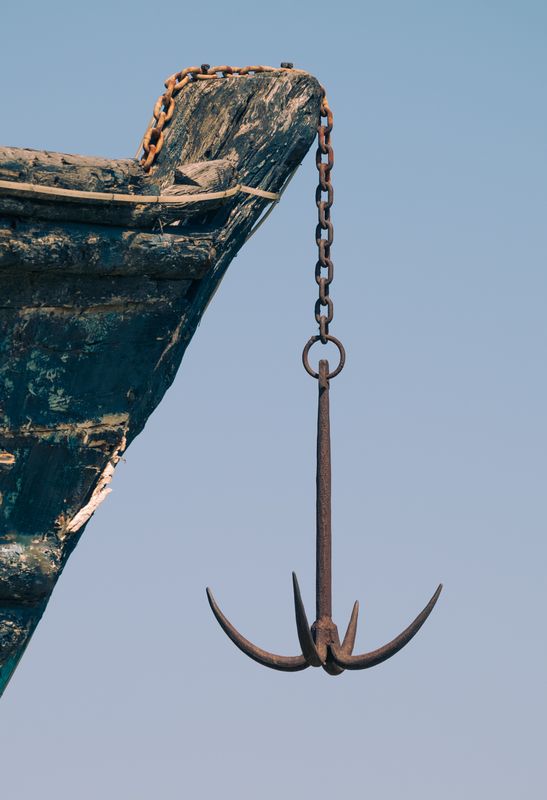
"Which hope we have as an anchor of the soul, both sure and stedfast, and which entereth into that within the veil." — Hebrews 6:19
The Question
Look at that one word — hope. In our everyday talk it means we are not sure: "I hope it will not rain" — meaning, it might. So is our "anchor of the soul" anchored to a maybe? Is Bible hope a wish that might fail, or a sure thing?
The Tool — walked together
First, bring the tools you already have, and ask your questions — this is a statement, not a command, so we ask what it declares. WHO? "we" — every believer; if you are saved, this hope is yours. WHAT? Our hope is "an anchor of the soul, both sure and stedfast." WHEN? The verse gives no time — an empty box. It is not telling us when; it is telling us what we hold. WHERE? Read on to the last word, and the verse answers: "within the veil." Hold that word — it is the sweetest in the verse, and the study will open it. WHY? The verse does not say outright — another empty box, and so our shovel — but everyone knows what an anchor is for: the storm.
Every box accounted for. Now run the rest of the toolbox. You read the whole verse to its last word, and it gave up "within the veil." This is no command but a statement, so the address tool rests this time. And when the weight fell on one word — hope — the tool that says let the Bible define its own words sent you looking for it elsewhere; it turns up in Titus 1:2. That brings us to this lesson's new tool — the one that says which verse gets the final say. TOOL #5: when one verse is hard, stand a clear one beside it, and let the plain light explain the deep. (Not sure where the plain verse is? The Helper page shows how to find every verse that uses the same word.) Hebrews 6:19 is deep — anchor, veil. Titus 1:2 is plain as day:
"In hope of eternal life, which God, that cannot lie, promised before the world began." — Titus 1:2
There is the daylight. Our hope is "of eternal life," resting on a promise — made by a God "that cannot lie." The plain verse settles the deep one: Bible hope is no wish, but sure, because the One who promised cannot lie.
ONE WORD
So take that word HOPE and hold it: in the Bible it is not a wish that may fail, but a confident expectation — a thing certain. The world's hope is a coin in the air; the Bible's is an anchor set in rock.
And what is the anchor made fast to? It reaches "within the veil" — into the very presence of God. But do not assume what that veil is; let the Bible say it. Further on, the same letter tells us plainly: "the veil, that is to say, his flesh" (Hebrews 10:20). The veil is the flesh of the Lord Jesus. So your anchor is made fast to Christ Himself. That is why it holds: an anchor is only as sure as what it grips, and yours grips the Lord. Let the wind blow; the soul anchored there does not drift.
Try It This Week
Here is your verse. Bring your questions, and read the whole thing to its last word — and when a heavy phrase looms up, find the plain one standing right beside it:
"And he said to them all, If any man will come after me, let him deny himself, and take up his cross daily, and follow me." — Luke 9:23
The heavy phrase is "take up his cross." It can frighten a new believer — it sounds like dying. But do not build on the shadow. Stand the plain words next to it, there in the same verse: "follow me." And one plain word more: "daily." So the great, heavy cross is explained by the plain command — follow Him, one ordinary day at a time. Not one grand and dreadful day, but this day, and then the next. That is how the cross is carried: by following.
Your Toolbox So Far
1. Start with the questions — WHO, WHAT, WHEN, WHERE, WHY. 2. Read the whole verse — all the way to its last word. 3. Every command has an address — ask who it was spoken to. 4. Let the Bible define its own words — the Book is its own dictionary. 5. Clear explains complex — let a plain verse light up a deep one.
Next lesson, in two weeks: a verse has neighbors — read the ones just before and just after, and a familiar saying turns out to mean more than we thought.
‹ Lesson 4 — Let the Bible Define Its Own Words • The Course Index — all lessons

No comments:
Post a Comment